
Grenada
& the Grenadines.
The southernmost charter base in the Eastern Caribbean — below the standard hurricane belt at 12 °N, so the season runs year-round. The launchpad for the Tobago Cays.
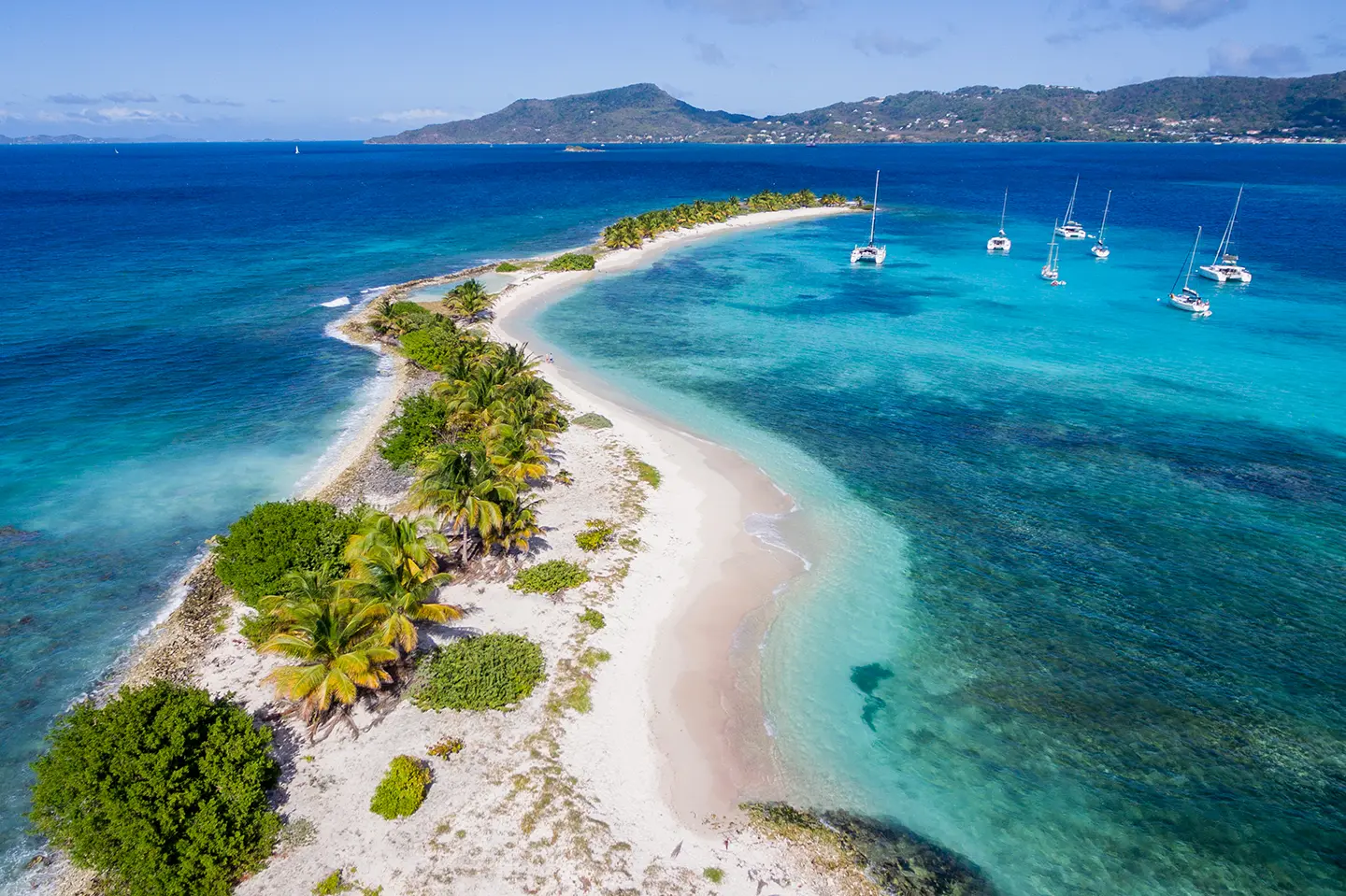
Catamaran charter Grenada is the southernmost charter base in the Eastern Caribbean and the most favoured launching pad for cruising the Grenadines. Port Louis Marina, on the St. George's lagoon, is the main hub — Dream Yacht Charter and Horizon Yacht Charters run the largest fleets there, with smaller operators (Sunsail through partner agreements, Caribbean Catamarans) adding hulls across December through July. Grenada also runs a secondary base at Clarkes Court Bay on the south coast, with another two operators servicing it.
Grenada's defining advantage is geography: the island sits at 12 °N latitude, below the standard hurricane belt that runs roughly 10-30 °N. Major hurricanes have struck (Ivan in 2004 was a Cat-3 direct hit, unprecedented in modern records), but the statistical risk is markedly lower than BVI, Antigua or Saint Martin. Most operators run year-round and insurance issues underwriting policies through the summer months — so June and July charters at 35-40% below February peak rates are routine here, and the September/October low-season window stays open for the patient charter shopper.
Routes from Grenada reach Carriacou (35 NM north, within Grenada's sovereign waters), Union Island, Mayreau, the Tobago Cays Marine Park (the most photogenic anchorage in the Eastern Caribbean) and on north into Bequia and Mustique in Saint Vincent and the Grenadines. The Tobago Cays Marine Park alone is the destination most Eastern-Caribbean charterers cross continents for — five uninhabited cays inside a horseshoe reef, 30-m visibility on the snorkel sites, sea turtles at Baradal moored to sand-only mooring buoys.
Beyond the wind and weather, Grenada is the cultural shift from BVI / Bahamas. The island runs on the EC dollar at a fixed peg (US$1 = EC$2.70), works English as the primary language with strong Creole and a Trinidadian-flavoured local culture, and stocks the supermarkets (IGA inside Port Louis Marina, the larger Foodland 5-minute taxi away) with a mix of Caribbean and US imports. Nutmeg, cinnamon, vanilla and chocolate are the local exports — Grenada is the Spice Island, and the Saturday morning Market Square in St. George's is the iconic spice-buying photo.
Port Louis Marina — the Grenada charter hub
Port Louis Marina sits on the southern shore of the St. George's lagoon — a protected basin formed by the volcanic-crater geography of the island's southwest. The marina is purpose-built for charter (opened 2008, expanded 2016), with 280 berths, a fuel dock, a chandlery (Spice Island Marine), three restaurants on the marina front (Victory Bar & Grill is the standard charter Saturday dinner), and the IGA supermarket on-site for provisioning runs.
Maurice Bishop International Airport (GND) is a 20-minute taxi south of Port Louis (~US$25), with direct flights from London (British Airways, Virgin Atlantic), Miami, New York and Toronto, plus connections via Barbados, Saint Lucia and Trinidad. Most charterers fly in Saturday morning and start the briefing at Port Louis the same afternoon — the marina runs staggered briefing slots from 12:00 to 16:00, with departures typically 14:00-17:00.
Clarkes Court Bay (the secondary base, 10 NM east of Port Louis on the south coast) hosts a smaller charter operation. It is the quieter option for first-time Grenada bareboaters who prefer a quieter overnight base before the briefing, with the trade-off that the first day's sailing is 10 NM less of west-coast progress than starting from Port Louis.
St. George's and the west coast
Most weeks begin with the west-coast morning. Provision in St. George's at the IGA inside the marina or the larger Foodland a five-minute taxi inland. Fuel at Port Louis is straightforward (open 07:00-17:00). The Saturday market in Market Square (07:00-13:00, central St. George's) is a worthwhile early start for the spices, fresh produce and the photo of the wooden-built Carenage waterfront.
Day-sail north along the leeward shore. The Underwater Sculpture Park in Molinière Bay (4 NM north of Port Louis) is a marine reserve with submerged sculptures by Jason deCaires Taylor; snorkel from the boat on the mooring buoys. Dragon Bay (further north) offers sand patches and good holding for a lunch-stop overnight. Halifax Harbour (6 NM north of Dragon) is a quiet alternative.
South-coast anchorages are the other Grenada cruising zone. Prickly Bay sits 5 NM east of Port Louis with shelter from northerly swell, easy shore access at the Sunrise Beach Restaurant, and the popular Tikiwiki sunset bar at Hog Island (a small island connected to the mainland by a sandbar at low tide — dinghy access only). The south coast bays (Prickly, Mt. Hartman, Hog Island, Westerhall, Calivigny) suit a quieter first or last night before the open-water push north.
Carriacou, Tyrell Bay and Sandy Island
Day three (or two on a 14-day charter) runs north to Carriacou — Grenada's largest dependency, 30 NM north of Port Louis. The passage is open-water sailing on the east side of the Grenadines chain — close reach in the typical easterly trades, occasionally beam reach. Customs clearance at Tyrell Bay when routing further north (the office sits on the main road, walking distance from the anchorage); for the south-bound return the clearance is the reverse.
Tyrell Bay (Carriacou) has moorings, services and calm nights with reliable holding. The Slipway Restaurant on the south shore is the standard charter dinner. Provisioning at the small grocery on the dock; the larger Patty's Deli in Hillsborough (Carriacou's main town, 3 NM north on the windward side) is the better stock-up.
Sandy Island is a marine protected area on the south side of Carriacou — bright sand and reef, anchor on sand only and follow the buoyed zones. Day-trip from Tyrell Bay; the anchorage is too small for overnighting. Hillsborough on the windward side has shops, bakeries and the small Carriacou Museum. Anse La Roche on the north end is the quiet swim stop in settled weather.
Union Island, Mayreau and the Tobago Cays
Crossing the Grenada-SVG border (15 NM north of Carriacou) opens the Grenadines proper. Check in at Clifton on Union Island — the customs office is on the main waterfront, walking distance from the anchorage. SVG clearance is EC$150 per visit; the office runs 08:00-16:00 weekdays (closed weekends except for emergencies). Most charterers spend a night at Clifton — the Anchorage Yacht Club has a small bar with sunset views over the kite-windsurfing zone of Frigate Island.
Mayreau (3 NM north of Union) is the small inhabited island between Union and the Tobago Cays. Salt Whistle Bay is the iconic anchorage — a narrow sand bar fringed by palm trees on the windward side, settled-weather only and limited space (12-15 boats maximum, arrive by 14:00 or take the alternative anchorage at Saline Bay on the lee side). Salt Whistle's bar (the Robert Righteous T-shirt-and-rum shack) is a Caribbean institution.
The Tobago Cays Marine Park (3 NM east of Mayreau) is the headline of the Eastern Caribbean and the destination most charterers cross continents for. Five uninhabited cays — Petit Rameau, Petit Bateau, Baradal, Petit Tabac and Jamesby — inside a horseshoe reef. Pick up park moorings where marked (sand-only zones); no fishing or collecting allowed. Snorkel with turtles at Baradal (the protected turtle reserve, sand-bottomed, 2-3 m water) and drift along Horseshoe Reef (the eastern edge, 15-m visibility on settled days). Park fees are EC$10-25 per person per night, collected by the warden boat. The Tobago Cays anchorage typically holds 30-50 charter boats inside the reef at peak season; nights are breezy and bright with no light pollution.
Bequia and the northern Grenadines
Bequia (15 NM north of the Tobago Cays) is the northernmost Grenadines stop on a typical Grenada charter and the iconic Caribbean small-island anchorage. Admiralty Bay is the main anchorage — sand-bottomed, holding excellent, 80-120 boats on a peak weekend, with the village of Port Elizabeth running along the waterfront. The Frangipani Hotel is the classic charter Saturday-evening dinner stop; the Whaleboner Bar takes its name from the literal whalebones in the bar frame.
Bequia has retained its whaling tradition (Saint Vincent is one of the few jurisdictions globally still allowed by the IWC to take a small number of humpback whales each year, all on Bequia by traditional sail-powered methods); the small Whaling Museum (Mt. Pleasant) is a respectful afternoon. Beyond the village, the long beach at Lower Bay is the swim afternoon. The Friendship Bay anchorage on the south side is the quieter alternative.
Mustique (8 NM north of Bequia) is the private-island anchorage — the Mustique Company manages the entire island and runs mooring-buoy fees at EC$200/night (no anchoring allowed). The Cotton House and Basil's Bar (the iconic stilt-built beach bar) are the two charter stops. Mustique is well-staged on a 14-day Grenada-Grenadines round-trip; 7-day charters stop at the Tobago Cays as the northern turn-around.
When to sail, what it costs
Peak Grenada season runs December 15 through April 30. Christmas / New Year weeks book 10-12 months ahead. February school-break (US and UK) is the second peak. March and April are easier to book at 4-6 months out. Day rates in peak: roughly US$7,500-13,000 per week for a 42-46 ft bareboat catamaran (slightly above Le Marin but still 15-20% below BVI). Crewed catamarans start US$17,000 per week all-inclusive.
Shoulder season (May, June, mid-November through mid-December) prices drop 25-35% — the same boat at US$5,000-9,000 per week. Below the hurricane belt, May through July remain excellent sailing months in Grenada specifically; insurance underwriting issues policies year-round at a 10-15% summer premium. Late July through October is the low-low season — 35-40% off peak rates, smaller fleet selection because some operators move catamarans to the Mediterranean or onto longer cruising charters, and a higher (but still modest) statistical hurricane risk.
Beyond the bareboat fee: fuel runs US$200-350 for a 40-46 ft catamaran on a 7-day week, end cleaning US$300, Tobago Cays park fees EC$10-25 per person per night (the standard 2-3 nights inside the park run EC$60-150 per person all in), SVG clearance EC$150 each way (round-trip EC$300). Provisioning runs roughly US$130-180 per person per day for a self-cooking crew — Grenada supply chain is mixed Caribbean / US sourcing, slightly cheaper than BVI but more expensive than Martinique. The full week-cost of a Grenada-to-Tobago Cays 7-day charter for a group of six typically runs US$15,000-22,000 all in.
Catamaran charter by marina in Grenada
Jump straight to the catamarans based at each Grenada marina. Every link opens the live fleet for that home port — useful if you already know where you want to start and finish your week.
Port Louis Marina catamaran charter
On the sheltered St. George’s lagoon, Port Louis is the purpose-built Grenada charter hub and the southernmost base in the Eastern Caribbean. From here the route runs north to Carriacou, Union Island and the Tobago Cays Marine Park.
View catamarans at Port Louis MarinaGrenada Yacht Club catamaran charter
In the same well-protected St. George’s lagoon just south of the capital, this is the quieter, smaller-fleet alternative on the Grenada south coast. It shares the open-water passage north up the Grenadines chain toward Carriacou and the Tobago Cays.
View catamarans at Grenada Yacht ClubGrenada — questions answered.
When is the best month for catamaran charter Grenada?
December through April is peak — steady 15-20 kt easterly trades, water at 27 °C. May and June are excellent value (30-40% off peak) with the same conditions. Uniquely in the Caribbean, Grenada stays open July through November — below the standard hurricane belt at 12 °N — so insurance still issues policies through the summer at a 10-15% premium. The September / October low season is the cheapest Eastern Caribbean window for catamarans.
Do I need to clear customs to visit the Grenadines?
Yes — the Grenadines (Union Island, Mayreau, Tobago Cays, Bequia, Mustique) are part of Saint Vincent and the Grenadines, a separate country from Grenada. Clear out at Carriacou (St. Patrick's) before crossing, clear in at Union Island (Clifton). SVG clearance is EC$150 per visit, payable in EC dollars or USD equivalent. We handle the paperwork checklist at briefing. Carriacou itself is part of Grenada — no separate clearance needed.
Is Grenada safe during hurricane season?
Grenada sits at 12 °N, below the standard hurricane belt that runs 10-30 °N. Major hurricanes have struck (Hurricane Ivan in 2004 was a Cat-3 direct hit, unprecedented in modern records), but the statistical risk is markedly lower than BVI, Antigua or Saint Martin. The 25-year average shows 1 major hurricane impact per decade in Grenada versus 2-3 in the BVI. Most operators run year-round and insurance underwriting reflects the lower risk via a manageable summer premium.
How long should I charter to reach the Tobago Cays?
Minimum 10 days for a comfortable Cays round-trip from Port Louis (Grenada → Carriacou → Union → Tobago Cays → Mayreau → return). 14 days adds Bequia and Mustique in the northern Grenadines, plus an unhurried 3 days inside the marine park. 7 days only reaches Carriacou — the Cays stay just out of reach without rushing the passages. Crewed charters can shorten the 7-day version by motoring some legs at higher speed.
What's included in a Grenada charter?
Yacht use, sails, dinghy with outboard, snorkel gear, bedding, full hull insurance. Not included: fuel (US$200-350/week), end cleaning (US$300), Tobago Cays park fees (EC$10-25 per person per night), SVG clearance (EC$150 each way), and on-board provisioning. We list every line in the offer.
What's the Grenada fleet?
150+ catamarans across Port Louis (Dream Yacht Charter, Horizon Yacht Charters) and Clarkes Court Bay (smaller operators). Lagoon 42, 46 and 50 dominate; Fountaine Pajot Saona 47 and Bali 4.6 also represented. The fleet is slightly older than BVI / Martinique on average — Grenada runs charters into the shoulder season, so hulls log more weeks. Most are 4-5 years old.
Can I sail one-way from Grenada to Saint Lucia or Martinique?
Yes — one-way charters from Grenada to Saint Lucia (Rodney Bay) or Martinique (Le Marin) are quoted as a 7-day or 10-day Grenada-Grenadines + delivery charter, with the one-way fee adding US$1,500-3,000 to a standard week. The route runs Grenada → Carriacou → Tobago Cays → Bequia → Saint Lucia, and is best in November or April when insurance for both ends is in effect. We coordinate the operator hand-off.
How does the Tobago Cays Marine Park work?
The Tobago Cays Marine Park is managed by the SVG government. Visitors pay a per-person per-night entry fee (EC$10-25, currently EC$10) collected by the park rangers in their patrol boat — they board your yacht when you arrive and issue a receipt. Pick up the white mooring buoys (sand-only zones); no anchoring on the seagrass. No fishing, no collecting (shells, coral, sand), no spearguns. The reef-snorkel sites (Horseshoe Reef on the east edge, Baradal turtle reserve) are unmissable. Most charterers spend 2-3 nights inside the park.
150+ catamarans based in Grenada
Browse the live Caribbean fleet — sailing catamarans, power catamarans, bareboat or fully crewed. Filter by dates and group size; we'll quote within hours.
Live availability · 72 h free cancellation · No booking fees
Pick a Grenada week — Tobago Cays included.
Tell us your dates and group — a Caribbean broker writes back with a costed offer, the SVG clearance checklist and the next available week from the Port Louis fleet.