The
Bahamas.
700 islands across 100,000 square miles of turquoise shallow water — sandbars, lagoons, beachside anchorages where a 1.2-metre keel drops the hook on white sand.
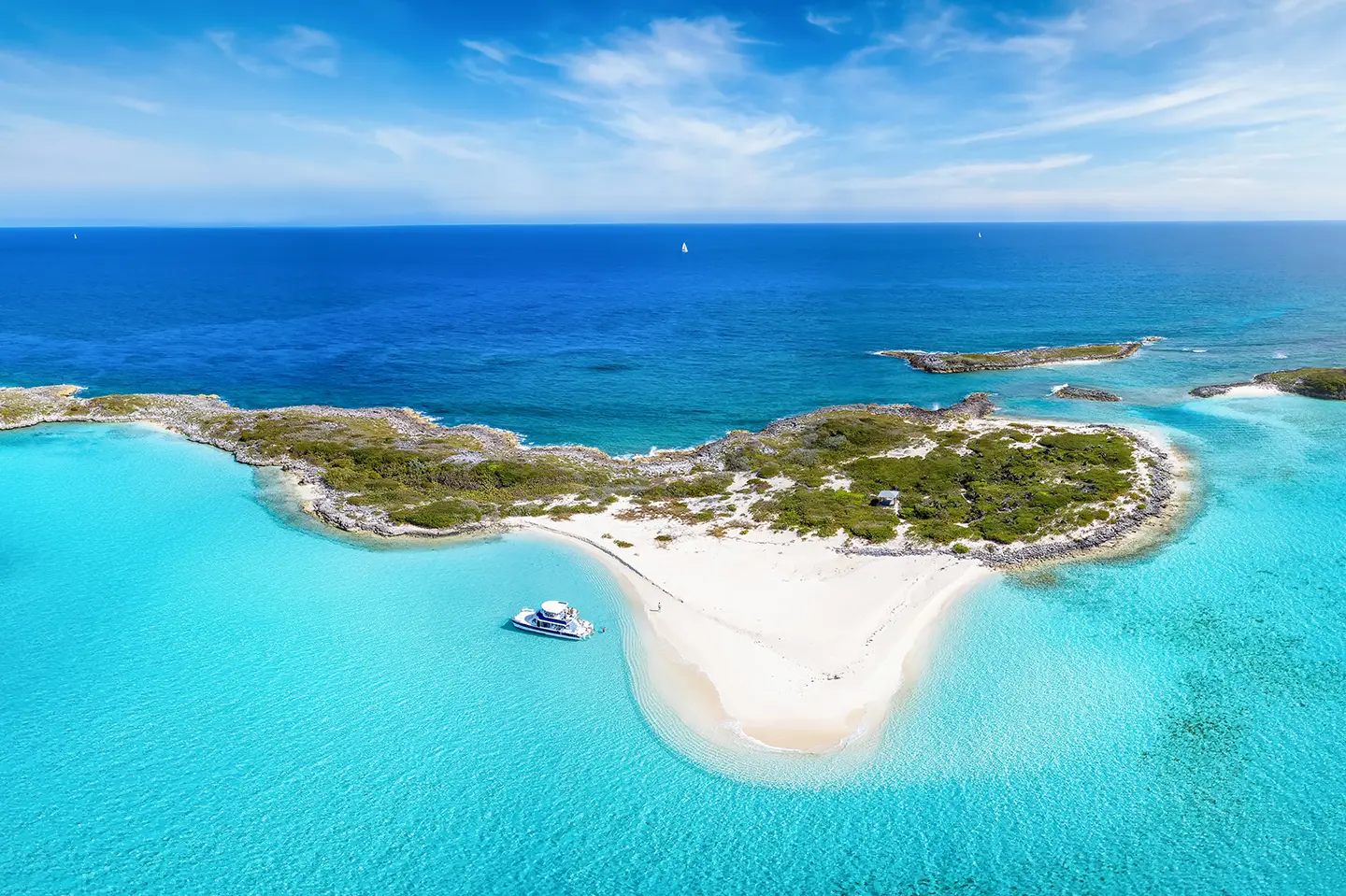
Catamaran charter Bahamas opens 700 islands across 100,000 square miles of turquoise shallow water. The geography defines everything else: shallow draft is exactly what the Sea of Abaco lagoon and the Exuma Bank reward — sandbars, mangrove creeks, and beachside anchorages where a 1.2-metre catamaran keel drops the hook on white sand inside a metre of clear water. The same anchorages are simply unreachable to a 2.0-metre monohull keel, which is why the Bahamas fleet skews even more strongly toward catamarans than the BVI does.
Two charter zones run independently. The Sea of Abaco (northern Bahamas, ~200 NM north of Nassau) is the shorter line-of-sight loop — Marsh Harbour to Hope Town, Great Guana, Green Turtle, Man-O-War, with mid-week stretches to Treasure Cay and Spanish Cay. The Exumas (central Bahamas, accessed from Nassau) are longer-distance — Nassau across the Yellow Bank to Highbourne, then south through the Exuma Cays Land and Sea Park to Staniel Cay, Big Major's Spot (the swimming pigs), and Compass Cay.
Wind in the Bahamas is steadier than further south — easterly trades hold 15-20 kt for 320 days a year. Cold fronts (Atlantic depressions sliding down the US east coast) push through November through February at roughly fortnightly intervals; each front brings 24-48 hours of north wind that closes the open Atlantic-facing anchorages. Catamaran charterers learn to read the front cycle from the briefing on. The water sits at 24-27 °C December through May, 28-30 °C June through October.
The Bahamas fleet runs roughly 200 catamarans split between two bases — about 100 hulls at Marsh Harbour (mostly Lagoon 42/46 across The Moorings, Sunsail, Dream Yacht Charter and a handful of smaller operators) and another 100 at Nassau (Sunsail, Dream Yacht, MarineMax). Power catamarans are stronger here than elsewhere in the Caribbean — Aquila, Sunreef, Leopard PC, MarineMax 443 — because the two-hour Yellow Bank crossing rewards motoring speed and the long shallow runs make a power-cat 25-knot transit comfortable in ways a sailing cat cannot match. Bareboat licence rules are stricter in the Bahamas than the BVI: most operators require an ICC plus a multi-day Caribbean sailing résumé.
Two bases — Nassau and Marsh Harbour
Nassau is the Bahamas capital and the southern charter hub. The marina cluster runs along the south shore of New Providence Island — Hurricane Hole Marina (Atlantis property), Albany Marina (high-end), Palm Cay Marina (mid-range), Bay Street Marina (city centre). Most bareboats depart from one of those four; provisioning at the Solomon's Fresh Market or the larger Bahamas Supermarket on Bay Street. Lynden Pindling International Airport (NAS) is a 20-25 minute taxi from each marina, with direct flights from Miami, Fort Lauderdale, Atlanta, New York and London.
Marsh Harbour is the Sea of Abaco hub — 200 NM north of Nassau, accessed via direct flights from Nassau (40 min, Bahamasair / Western Air) or via a connection from Miami or Fort Lauderdale (1 hour each). Marsh Harbour itself is a working town with a fuel dock, two supermarkets (Maxwell's and the Marsh Harbour Plaza), and a handful of restaurants. The Moorings base at Conch Inn Marina is the main bareboat dock; Cruise Abaco operates a smaller fleet from the adjacent marina.
Choosing between the two: Marsh Harbour for line-of-sight shallow-water cruising, shorter hops, the iconic Hope Town candy-stripe lighthouse, and the easiest Bahamas first charter. Nassau for the Exumas — the photogenic, Instagram-famous side of the Bahamas with pig beach, Thunderball Grotto, and the Exuma Cays Land and Sea Park. The two bases do not connect on a standard 7-day week (130 NM crossing required); a 14-day charter can chain them with one planned crossing day.
Nassau and the central Exumas
Day one out of Nassau is the Yellow Bank crossing — 35 NM east across shallow open water to Highbourne Cay, typically 5-7 hours under sail or 3-4 hours motoring. Highbourne is the first Exuma stop with services (fuel, water, mini-market) and a settled overnight anchorage. From Highbourne the route runs south down the chain.
Allen's Cay (5 NM south of Highbourne) is the iguana stop — the protected Bahamas Rock Iguanas live wild on the beach. Approach at low water and keep distance; the iguanas are not pets and bite if fed. Norman's Cay (10 NM south) has a shallow C-46 wreck for snorkelling — settled-weather only, exposed to north wind. Shroud Cay has mangrove creeks you explore by tender at mid-tide — one of the highlights of the central Exumas, a narrow tidal river through a low salt marsh.
Warderick Wells is the Exuma Cays Land and Sea Park headquarters — moorings only, no fishing, no collecting, no anchor on the seagrass. Park fees are paid to the warden boat. Most charterers spend two days at Warderick Wells (Boo-Boo Hill walk, the whale-skeleton trail, the snorkel sites at Coral Garden) before continuing south.
Staniel Cay and Compass Cay
Staniel Cay (40 NM south of Highbourne, day four or five) is the central Exuma highlight. Fuel and water at Staniel Cay Yacht Club; provisioning at the small Pink Pearl supermarket on the dock. Time Thunderball Grotto for slack water (printed tide charts on the dock) and good light — the cave system is unmissable but the current at flood is real. The grotto is shared with day-trippers from Nassau; arrive 7:00-9:00 for the quiet shoot.
Big Major's Spot is the famous pig beach, 1 NM north of Staniel Cay. Anchor on the leeward side and tender ashore; keep a safe distance from the pigs and never feed from the dinghy (the pigs bite the dinghy thinking it is food). Two pig deaths in 2019 were linked to careless tourist feeding; the local guides now police the beach in season.
Compass Cay (5 NM north of Staniel) has nurse sharks at the dock — a posted-fee experience (US$10 per person), shallow water, completely safe. The marina has a small bar and ice. Pipe Creek (a chain of shallow cays north of Compass) lights up at low tide with sandbars and clear sand-bottomed channels. Watch depths and current around the cuts; anchor on sand only, back down hard. The southern run continues to Black Point Settlement (laundry and bakery), Cave Cay Cut (the deep-water crossing back to the Atlantic side) and Musha Cay.
Sea of Abaco — Marsh Harbour, Hope Town, Great Guana
Marsh Harbour is the Abaco charter base — protected anchorage, full provisioning at Maxwell's supermarket, mechanics on the dock, fuel and water at the Conch Inn Marina. Day one is usually Hope Town (5 NM east) for the candy-striped lighthouse and the inner-harbour mooring field — the harbour is narrow with a marked entrance, mooring buoys only, no anchoring inside the protected basin.
Hope Town's lighthouse is the most-photographed structure in the Bahamas. Climb the 101 steps for the panoramic view; check the Wyannie Malone Historical Museum for the loyalist-Bahamian heritage detail. Hope Town's beach on the Atlantic side runs the length of Elbow Cay with reef breaks for snorkelling.
Great Guana Cay (8 NM north of Hope Town) is the long-beach Atlantic anchorage. Nipper's Beach Bar on the dune is the iconic Abaco scene — Sunday pig roast since 1996 (about 40 charter boats on the mooring most Sundays). Green Turtle Cay closes the typical Abaco loop — two harbours (White Sound for the Bluff House dock, Black Sound for the New Plymouth Yacht Club), the small loyalist town of New Plymouth, and the easiest beach-bar dinghy ride in the Bahamas.
Out-island routing — Berry Islands and Eleuthera
Beyond the two main charter zones, the Bahamas opens into the out-islands — Berry, Eleuthera, Long Island, Cat Island, Crooked Island. These are reachable only on 10-14 day charters with one or two planned crossing days. The Berry Islands (between Nassau and Marsh Harbour) work as a stepping-stone on Nassau-to-Abaco passages — Great Harbour Cay, Hoffman's Cay, the underwater blue holes off Hoffman's.
Eleuthera (east of the Exumas) is the longest-beach island in the Bahamas — 100 miles of pink sand on the Atlantic side. Charter access from Nassau is a 50 NM crossing east; the main stops are Spanish Wells (the loyalist fishing village at the north end), Harbour Island (Pink Sands Beach), and Governor's Harbour. Most charterers add Eleuthera only on a 14-day Nassau-based charter.
Long Island, Cat Island and the Ragged Island chain are remote — sparse provisioning, limited fuel docks, hurricane-window only for serious passage-makers. We rarely route bareboats this far; ask if your group wants a crewed catamaran for a Long Island week — the route opens up with a captain who knows the chain.
When to sail, what it costs
Peak Bahamas season runs December 15 through April 30. Christmas / New Year weeks are the busiest — book 10-12 months ahead for catamarans in Marsh Harbour or Nassau. Spring break (March) is the second peak; Easter weeks fill 4 months out. Day rates in peak run roughly US$7,500-13,500 per week for a 42-46 ft bareboat catamaran; power catamarans run US$9,500-16,000 per week. Crewed catamarans (42-56 ft) start US$18,000 per week all-inclusive.
Shoulder season (May, June, mid-November through mid-December) prices drop 25-35% — the same boat at US$5,000-9,000 per week. Hurricane window blocks July through November for most operators (Bahamas sits on the standard hurricane track). November reopens the fleet with last-minute availability before the December peak.
Beyond the bareboat fee, the Bahamas charges a Cruising Permit (~US$300 for the season) at clearance in Nassau or Marsh Harbour, plus a fishing permit (~US$30) if you want to drop a line for trolling. Park fees at the Exuma Cays Land and Sea Park run US$10-15 per night per boat. Provisioning is expensive — most goods are imported from the US and supermarket prices run 30-40% above Florida. Budget US$140-200 per person per day for self-provisioned crews.
Catamaran charter by marina in Bahamas
Jump straight to the catamarans based at each Bahamas marina. Every link opens the live fleet for that home port — useful if you already know where you want to start and finish your week.
Nassau (Palm Cay Marina) catamaran charter
On the south-east shore of New Providence near Nassau, this is the main Nassau-side catamaran base and the launch point for the Exumas. Day one is the Yellow Bank crossing east to Highbourne Cay and the long run down the Exuma chain to Staniel Cay and the swimming pigs.
View catamarans at Nassau (Palm Cay Marina)Abaco (Boat Harbour Marina) catamaran charter
At Marsh Harbour on Great Abaco, this is the principal base for the sheltered Sea of Abaco loop. Hope Town’s candy-striped lighthouse, Great Guana Cay and Green Turtle Cay are all short, line-of-sight hops across protected water.
View catamarans at Abaco (Boat Harbour Marina)Conch Inn Marina catamaran charter
In the heart of Marsh Harbour on the Abaco waterfront, a second Abaco catamaran dock with fuel and provisioning on hand for the start of the week. It opens straight onto the Sea of Abaco and the run east to Elbow Cay and Hope Town.
View catamarans at Conch Inn MarinaBahamas — questions answered.
When is the best month for catamaran charter Bahamas?
December through April is peak — steady 15-20 kt easterly trades, water at 25-26 °C, clear shallow visibility. May and June stay reliable with fewer crowds and 25-35% off peak rates. July through October is hurricane window — most operators close. November reopens with the fleet refreshed and availability inside 6 weeks. Cold fronts (24-48 hours of north wind) pass roughly fortnightly November-February — easily worked around in the charter plan.
Do I need a cruising permit for the Bahamas?
Yes — every charter yacht needs a Bahamas Cruising Permit (~US$300 for the season) handled at clearance in Nassau or Marsh Harbour, plus a fishing permit (~US$30) if you want to drop a line. The cruising permit covers the whole archipelago for the charter duration; the fishing permit covers trolling lines but does not authorise spearfishing inside the marine parks. Permits are issued same-day at the customs office; bring boat papers, passport and the credit card.
How does the Bahamas compare to the BVI?
BVI is line-of-sight sailing inside a single channel — shorter hops, easier first charter, busier anchorages, lighter paperwork. Bahamas trades that for shallow-water cruising, sandbars and mangrove lagoons impossible to reach from a deeper-draft yacht, and significantly fewer charter boats per square mile. Bahamas needs slightly more planning (cruising permit, cold fronts, longer crossings) but rewards it with quieter anchorages and pink-sand beaches. Both are catamaran-dominant fleets.
Can I sail from Nassau to the Abacos in one charter?
Not in a standard 7-day week — Nassau to Marsh Harbour is a 130 NM crossing across the Northwest Providence Channel. The two bases run separate itineraries: Nassau reaches the central Exumas, Marsh Harbour stays in the Sea of Abaco. A 14-day charter can chain Exumas and Abacos with a planned crossing day via the Berry Islands as a stepping-stone. We'll plot the weather window — typically settled trades, no cold front in the 72-hour forecast.
What's the Bahamas catamaran fleet?
Roughly 100 catamarans at Marsh Harbour (Lagoon 42/46 dominant across The Moorings, Sunsail, Dream Yacht Charter, Cruise Abaco) and another 100 at Nassau (Sunsail, Dream Yacht, MarineMax). Power catamarans are stronger here than elsewhere — Aquila 36/44, Sunreef Power, Leopard PC 53, MarineMax 443. Most sailing cats are 3-4 years old; charter fleets refresh on a 4-year cycle.
How far ahead should I book a Bahamas catamaran?
Christmas / New Year: 10-12 months. Spring break and Easter: 6-8 months. January and March: 4-6 months. May / June: 2-3 months. Last-minute (mid-November to mid-December as the fleet reopens) the early December weeks frequently have availability inside 4 weeks.
Are bareboat licence requirements stricter than the BVI?
Marginally. Most Bahamas operators require an ICC, USCG licence, RYA Day Skipper or equivalent, plus a documented Caribbean charter résumé showing at least one prior charter on a similar-size vessel. First-time Caribbean bareboaters are often steered toward a skippered start — easy to add a captain at US$240-300 per day if the operator wants additional reassurance. For crewed catamarans no licence required.
What is the Exuma Cays Land and Sea Park and do I need to plan around it?
The Exuma Cays Land and Sea Park (ECLSP) is the central Exuma marine reserve — a 22-mile strip running from Wax Cay Cut in the north to Conch Cut in the south. Inside the park: moorings only (no anchoring on seagrass), no fishing, no collecting of anything (shells, sand, coral). Park fees are paid in cash or card to the warden boat at Warderick Wells (US$10-15 per night per boat). Plan two days inside the park — Warderick Wells for the walks and snorkel, Shroud Cay for the mangrove creek.
200+ catamarans based in Bahamas
Browse the live Caribbean fleet — sailing catamarans, power catamarans, bareboat or fully crewed. Filter by dates and group size; we'll quote within hours.
Live availability · 72 h free cancellation · No booking fees
Pick a Bahamas week — we'll quote inside one working day.
Tell us Abacos or Exumas, dates and group size — a Caribbean broker writes back with a costed offer and the cruising-permit checklist.