
Four zones,
one trade wind.
The Caribbean strings 7,000 islands across four sailing zones — BVI in the Leewards, Bahamas to the north, Martinique in the French West Indies, Grenada and the Grenadines at the southern arc. Pick a base — every one is a different week.
7,000 islands, four sailing zones.
The Caribbean strings 7,000+ islands across four sailing zones — the Bahamas in the north, the BVI as a tight cluster in the Leewards, Martinique in the heart of the French West Indies, Grenada and the Grenadines at the southern arc. Trade-wind sailing is line-of-sight: every island is in view of the next, every channel runs in a roughly predictable direction. A yacht in the Caribbean rarely sails more than three hours between anchorages — and every direction surfaces a new beach, a new reef, a new island flavour.
Peak season runs December through April — steady 15-22 kt easterly trades, water at 26-28 °C, virtually zero rain. May and June are the brokers' shoulder: identical sailing, 25-35% cheaper, all the same destinations. July through November is hurricane window across most of the Caribbean — but Grenada at 12 °N sits below the standard hurricane belt, so its season runs year-round. Caribbean weather is more predictable than Mediterranean: the trade winds blow on a clock.
Bareboat catamarans dominate the Caribbean fleet — Lagoon, Bali, Leopard, Fountaine Pajot all built in the 38-50 ft range that suits the region's anchorages. BVI runs roughly 400 bareboat catamarans across MarineMax, Dream Yacht and Sunsail; Le Marin in Martinique runs the largest single base in the Eastern Caribbean at 400+ hulls. Bahamas and Grenada add another 200 each. Crewed superyachts cluster around BVI, Antigua and St. Lucia — bookings from US$50,000 to US$300,000 per week.
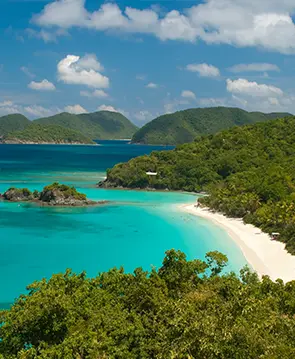
British Virgin Islands
Sir Francis Drake Channel runs east-west through a forty-island archipelago — line-of-sight sailing, 15-22 knot easterly trades, the easiest first bareboat in the Caribbean. Charter from Road Town or Nanny Cay on Tortola, reach Norman Island and The Indians on day one, push out to Anegada by Wednesday, finish the loop at Jost Van Dyke. Catamarans dominate the BVI fleet because shallow draft opens sand-bottomed bays that monohulls admire from deeper out.
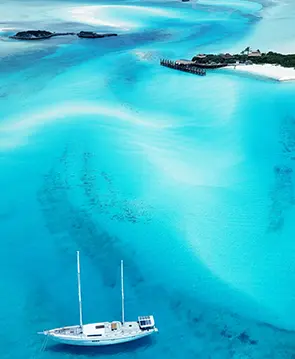
Bahamas
700 islands across 100,000 square miles of turquoise shallow water. Shallow draft is rewarded — sandbars, lagoons, beachside anchorages where a 1.2-metre keel drops the hook on white sand. Steady 15-20 kt easterly trades, water at 30 °C in summer, short line-of-sight passages between Hope Town, Great Guana, Green Turtle and Man-O-War in the Abacos. Nassau-based charters reach the central Exumas — swimming pigs and Thunderball Grotto across a 35-NM Yellow Bank crossing.
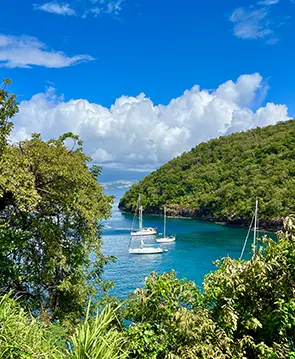
Martinique
Le Marin is the largest charter base in the Eastern Caribbean — 400+ catamarans across Dream Yacht Charter, The Moorings, Sunsail. As an overseas département of France, Martinique uses the euro, stocks Carrefour and Leader Price, and offers the best provisioning in the region — fresh baguette, Atlantic-imported cheese, French wine, and Lagoon catamarans built 40 km north in La Rochelle. Charter on the protected lee coast — 35-mile arc from Saint-Pierre past Fort-de-France, the Anses d’Arlet and Diamond Rock down to Le Marin.
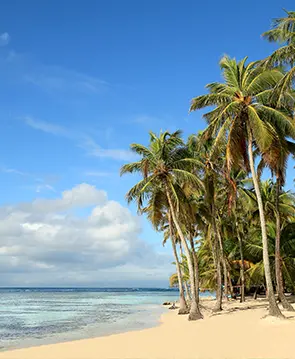
Grenada
Southernmost charter base in the Eastern Caribbean and the launchpad for the Grenadines. Port Louis Marina on St. George's lagoon is the hub — Dream Yacht Charter, Horizon Yacht Charters and several smaller operators run fleets December through July. Uniquely, Grenada sits below the standard hurricane belt at 12 °N — insurance windows extend later than anywhere on the BVI-Antigua arc, so June and July charters at 35-40% below February peak rates are routine here.
The Caribbean year, broken into four.
Peak runs the northern winter and tails into June. July through November is hurricane window, when most operators close and Grenada — below the standard belt — keeps sailing.
Air 26-29 °C, water 26 °C, easterly trades 15-22 kt by mid-morning. Marinas booked 6-12 months out — Christmas / New Year is the busiest stretch of the year. Lock catamarans in by spring at the latest.
Same easterly trades, water warming to 27 °C, longer daylight. Spring-break weeks (March) cost more than mid-March or April. Easter is a strong booking week — usually full 4 months ahead.
Identical sailing conditions, 25-35% cheaper. Trade winds soften to 12-18 kt — easier for first-time crews. Hurricane risk still effectively zero until mid-June. Best value-for-week of the entire Caribbean calendar.
Most operators close in BVI / Bahamas / Martinique through October. Grenada at 12 °N stays open year-round and offers 35-40% off February rates. Late November reopens the full fleet — bookable last-minute if pricing matters more than catamaran choice.
Pick a base. Then we'll
plot the week.
Four routes our brokers would plan themselves. Each is a starting point — we adjust the stops to weather, your group, and the kind of week you want.
See suggested itineraries →What clients usually ask.
- Which Caribbean destination for first-time charterers?
- British Virgin Islands. Line-of-sight sailing inside Sir Francis Drake Channel, forty-plus islands clustered within a thirty-NM radius, steady 15–22 kt easterly trades, and the largest bareboat fleet in the region — any first-time crew can build a comfortable week without long passages or open-water legs.
- Do I need a sailing licence to charter in the Caribbean?
- For bareboat charter you need an ICC (International Certificate of Competence), a US Coast Guard licence, RYA Day Skipper, or an equivalent national licence — plus documented experience on a similar-size yacht. For skippered or crewed charters no licence is needed; we put a local-licensed skipper aboard who handles navigation, mooring and the charter formalities.
- What's the difference between bareboat, skippered and crewed?
- Bareboat: you skipper yourself, licence required, lowest day rate. Skippered: we add a professional captain (about US$220–280/day); you still cook and crew. Crewed: captain plus chef and/or hostess on board, all meals and provisioning handled — the price difference is roughly 35–50% over bareboat for the full-service experience.
- When is the best time to sail the Caribbean?
- December through April is the high season — steady 15–22 kt easterly trades, water at 26–28 °C, no rain. May and June are the brokers' favourite shoulder: same conditions, 25–35% cheaper. July through November is hurricane window — most operators close in BVI / Bahamas / Martinique, but Grenada at 12 °N sits below the standard hurricane belt and runs year-round.
- How early should I reserve a Caribbean catamaran by season?
- For Christmas, New Year and February school-holiday weeks: 8–12 months ahead for catamarans. For January and March: 4–6 months works. For shoulder May–June and Grenada year-round: 2–3 months is usually enough. We hold soft options for up to 7 days while you confirm the group.
- What's included in the charter price?
- Yacht use, base equipment (sails, dinghy with outboard, snorkelling gear, bedding, towels), full hull insurance, and third-party liability. Not included: fuel, base port fees, end cleaning, cruising permits (Bahamas ~US$300, SVG EC$150), national-park fees (Tobago Cays, Exuma Cays Land & Sea Park), and on-board provisioning. We list every line in the offer so the invoice matches the quote — 72-hour free cancellation from booking.