
Plot the
whole week.
Sample 7- and 14-day Caribbean catamaran routes our brokers would plan themselves. Each is a starting point — we adjust the stops to weather, your group, and the kind of week you want.
A Caribbean week has a rhythm.
Three things shape every Caribbean charter — the Saturday turnaround, a sensible daily mile count, and the skipper's freedom to re-plot on the day. Once those are clear, picking a starting region is the easy part.
Caribbean charter weeks run Saturday-to-Saturday. Embarkation at 5 pm Saturday after the cleaning team finishes; disembarkation at 9 am the following Saturday. Some bases (BVI, Le Marin) run shoulder-season Wednesday turnarounds when the fleet has space. Two-week charters chain a Saturday hand-off in the middle — same yacht or upgrade to a larger one for the second week.
Plan for 20–35 NM on sailing days — catamaran cruise speed of 7–9 kt makes a 30-NM leg a comfortable 4-hour day with a swim stop. A 7-day week comfortably covers 90–180 NM, depending on the route. BVI runs short (92 NM total on the classic loop), Bahamas medium (~110 NM Abacos, 150+ NM Exumas), Grenadines long (180+ NM on the 10-day round-trip to Tobago Cays).
Every route here is a starting point. The skipper re-plots day-by-day on the trade-wind forecast, cold-front sequence (Bahamas), cruising-permit timing, the group's stamina, and whether you'd rather chase a quieter anchorage or the beach-bar scene. Pre-departure briefing covers the planned week; on board, the skipper updates each morning on VHF Channel 16.
Every route, by sailing area.
Pick the corner of the Caribbean that fits your week — each card opens onto every route from that base, day-by-day. We adapt the stops to weather, your group, and the kind of week you want.
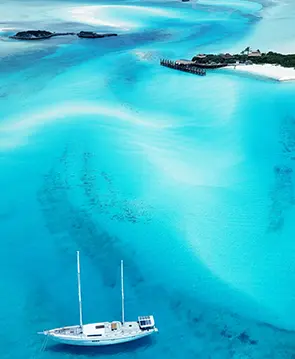
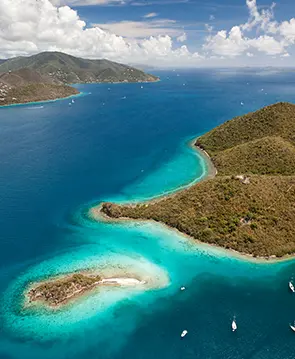
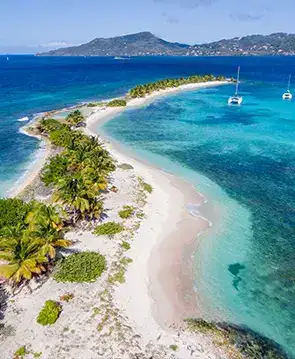
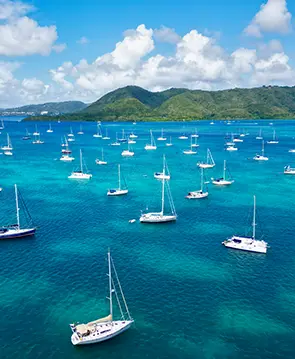
What 20–35 NM actually looks like.
A typical day on a Caribbean catamaran charter — half sailing, half ashore. A morning snorkel stop, a long lunch at anchor, the afternoon trade-wind reach, a beach-bar dinner in port.
Coffee on deck, fresh bread from the marina bakery (or the night-before provisioning), trade-wind check before slipping the lines.
Engine out of the anchorage, then sails up on the easterly trades. A swim stop at a snorkel reef around mid-morning — The Indians, Coral Garden, the Underwater Sculpture Park.
Hove-to or moored in a quiet bay. Light meal on deck, an afternoon swim. The Caribbean midday sun rewards a shade-stretched lunch.
Easterly fills to 18–22 kt by 2 pm reliably. Two to three hours of beam-reach sailing to the evening anchorage — the day-sail of the week.
Lines on a National Parks Trust mooring or anchor on white sand. Showers on board, swim before sunset, the skipper books a beach-bar dinner ashore.
Beach-bar dinner — Foxy's at Jost Van Dyke, Nipper's at Great Guana, Salt Whistle Bay at Mayreau, the Frangipani on Bequia. Local rum, fresh fish or lobster. Back on board by 11 pm.
How to choose a Caribbean charter route.
The Caribbean basin gives you four distinct charter regions, each with its own character. The classic catamaran charter Caribbean week is built around one of them — but a two-week charter or a one-way crossing lets you stitch two together. Below is the short version: who each area suits, how the typical Saturday-to-Saturday week looks, and what to weigh up when you pick.
Whatever route you pick, the rhythm is similar: morning swim and snorkel, midday sail on the steady easterly trades, late-afternoon arrival in a sheltered cove or marina, dinner ashore at a beach bar. Distances are short — most days are 20–35 NM, leaving plenty of time at anchor. National-park permits (BVI National Parks Trust, Tobago Cays Marine Park, Bahamas Cruising Permit) are handled by our team when you book.
What clients ask about routes.
Tailor this route to your week.
Send a brief. A broker will adapt the route to your group, the trade-wind forecast, and the kind of week you want.