
Martinique
& Le Marin.
Le Marin is the largest charter base in the Eastern Caribbean — 400+ catamarans, euro pricing, French provisioning, and Lagoon catamarans built 40 km north in La Rochelle.
Catamaran charter Martinique runs from Le Marin — the largest charter base in the Eastern Caribbean, with over 400 catamarans across Dream Yacht Charter, The Moorings, Sunsail, Cap Adventures, Locasail, Punch Croisières and a dozen smaller operators. The scale matters: Le Marin's catamaran density is roughly four times the BVI's per square mile of charter zone, which translates directly into competitive day rates (typically 15-25% below the BVI for an equivalent boat) and the deepest choice of catamaran model in the Caribbean.
Martinique is an overseas département of France, which sets the region apart in three ways. First, the currency is the euro — there is no USD exchange overhead, and chartered yachts pay marina and fuel fees in the same currency the rest of Europe is used to. Second, the supply chain is direct from mainland France: Carrefour, Leader Price, Géant Casino and Super U stock Atlantic-imported cheese, fresh baguette, French wine, charcuterie and the full range of French provisioning at supermarket prices the rest of the Caribbean cannot match. Third, Lagoon catamarans — the most-chartered cat brand in the Caribbean — are built in La Rochelle on the French Atlantic coast and shipped to Le Marin in lots of 30-40 hulls; the Le Marin fleet runs the freshest Lagoon stock in the region.
Charter activity happens on the protected Caribbean (lee) coast — a 35-mile arc from Saint-Pierre at the north end past Fort-de-France in the middle, the Anses d'Arlet trio of bays, Diamond Rock anchorage, and Le Marin / Sainte-Anne at the southern tip. Trade winds blow 15-20 kt from the east; the lee coast stays calm because Mount Pelée (1,397 m, the dominant northern volcano) and the smaller central volcanic chain break the easterly air. Atlantic-side anchorages on the windward coast exist but are not part of standard charter routing — exposed swell, less infrastructure, longer passages.
Beyond the standard Martinique week, two onward routes open from Le Marin. South to Saint Lucia (Rodney Bay or Marigot Bay, 22-NM crossing) is the easier add-on for 10-14 day charters — settled trade-wind reach, French and English Caribbean alternating. North to Dominica (45 NM) is the harder add-on — open-water passage past Diamond Rock, into the Dominica Channel. Both crossings require formal customs clearance; we handle paperwork at briefing.
Le Marin base — the largest charter dock in the Eastern Caribbean
Le Marin sits at the southern tip of Martinique, inside a protected bay (Cul-de-Sac du Marin) that handles the prevailing easterly trades on the lee side of the island. The marina complex runs along the north shore of the bay — Dream Yacht Charter has the largest single dock with 150+ hulls, The Moorings / Sunsail run a combined 100, with the remainder split between Cap Adventures, Locasail and the smaller operators. The marina runs a fuel dock, a chandlery (Polmar, Yachting Caraïbes), three restaurants and a small supermarket on the dock.
Provisioning happens at the Leader Price 800 m walk from the marina or the larger Hyper U Carrefour 3 km east (cabs or rental car for the heavy provisioning run). Both supermarkets stock fresh baguette, French cheese, wine, beer (Lorraine and Carib local, plus French and Belgian imports), charcuterie, fresh local fish at the Marin fish market on the dock. Saturday morning farmers' market in Le Marin town centre runs 06:00-11:30 with local produce, hot peppers, plantains, fresh herbs.
Fort-de-France International Airport (FDF) is a 25-minute taxi from Le Marin (~€35) with direct flights from Paris (Air France, Air Caraïbes, Corsair) and connections from London, Miami, Montreal and the rest of the French Caribbean. Many EU charterers take the daytime Air France from Paris-Orly (8.5 hours direct) and start the briefing at Le Marin the same afternoon. The briefing itself takes 90-120 minutes; departures typically 14:00-17:00 Saturday with the first overnight at Sainte-Anne.
Sainte-Anne and the southern anchorages
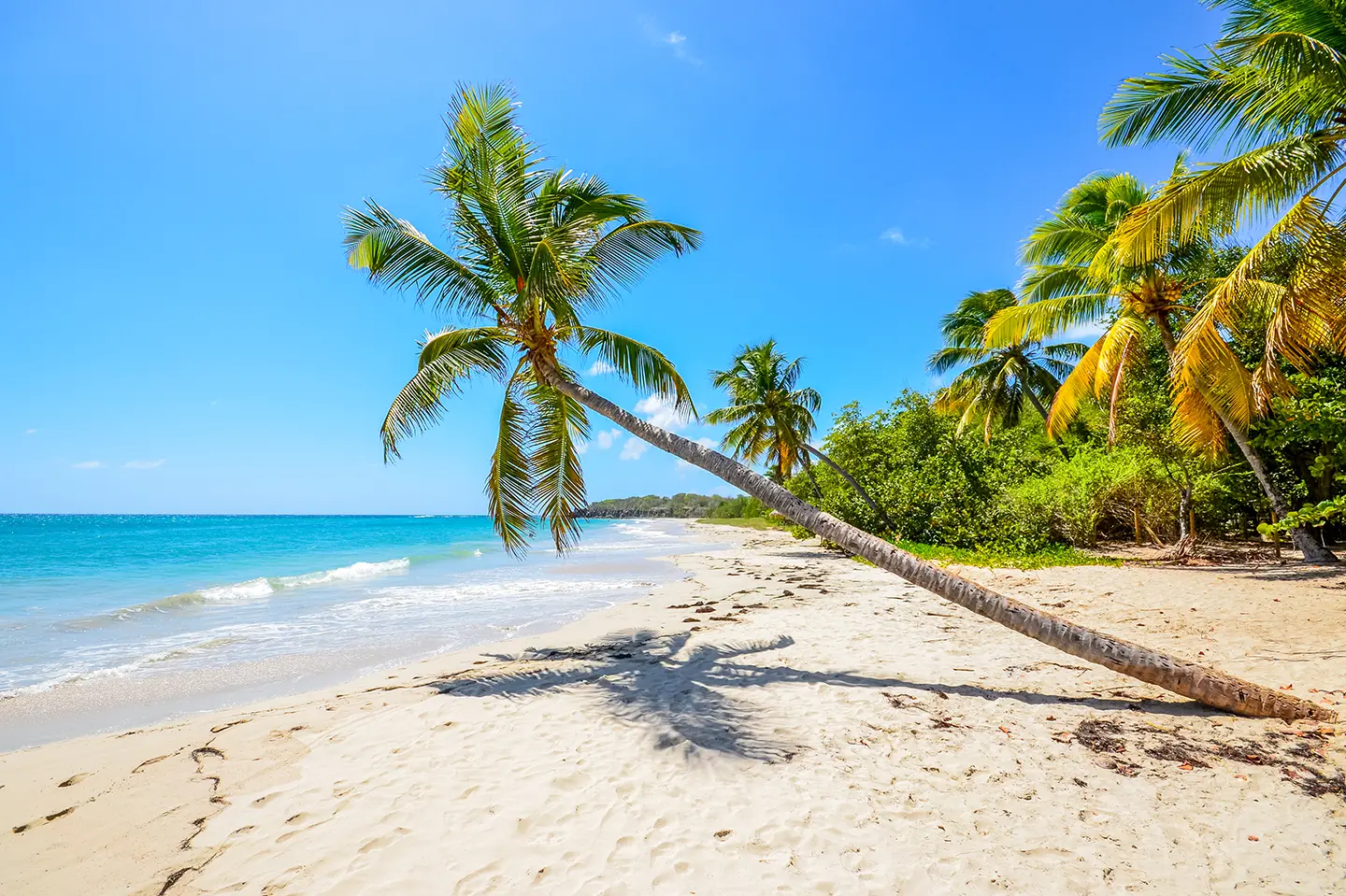
Sainte-Anne sits 3 NM east of Le Marin marina, around the headland of Pointe Marin. The anchorage is the standard first-night Martinique stop — sand-bottomed, holding good, 80-100 boats on a peak-season weekend, but plenty of room across the wide bay. The village of Sainte-Anne has restaurants, a small supermarket, a Saturday-morning market and the church square that anchors the seafront. The Plage des Salines (a 5-km long Atlantic-side beach on the far south point) is a 20-minute taxi ride away — the iconic Martinique beach photo.
From Sainte-Anne, day-trips run to the Îlets aux Pigeons (the marine reserve 4 NM offshore — moored snorkelling, no anchoring on the seagrass) and the Baie des Anglais (a quieter anchorage 5 NM east, sheltered from north swell, sand and seagrass). Most charterers spend two nights between Le Marin and Sainte-Anne before pushing north to the Anses d'Arlet trio.
Pointe du Marin and the small reef-fringed Cul-de-Sac du Marin shallows are not part of normal cruising — too shallow for charter cats, fishing-boat zone only. Stay in the marked channel.
The Anses d'Arlet trio — Grande Anse, Anse Noire, Anse Dufour
Sailing north from Sainte-Anne, the lee coast opens with three small bays clustered around the village of Anses d'Arlet. Grande Anse d'Arlet is the largest — sand patches and easy shore access, restaurants on the beach (Ti Sable, La Belle Plage), supermarket 5-minute walk inland. The village church faces directly down the beach in the iconic Martinique postcard shot. Holding good on sand; the bay handles 30-40 boats on a peak weekend.
Anse Noire (1 NM north) has a small black-sand beach with good snorkelling along the volcanic rocks. The anchorage is tighter — 8-10 boats maximum, sand patches only, no anchoring on seagrass. Boutique restaurant on the beach for lunch.
Anse Dufour sits immediately next door with turtles in the seagrass beds. Keep distance from the turtles, never touch or feed wildlife (the marine park rules are enforced by the local guide service); anchor on sand only inside the buoyed zone. The trio works as a three-stop day or a two-night stretch — picnic ashore at lunch, snorkel mid-afternoon, dinner on the boat. Sunset across the bay is the iconic Anses d'Arlet evening shot.
Fort-de-France and Saint-Pierre
Fort-de-France Bay (10 NM north of Anses d'Arlet) is the central Martinique anchorage — close to the capital, ferry connections, repair shops, the better marine chandleries (Polmar, Yachting Caraïbes), the French naval base (Fort Saint-Louis) and the colonial-era town centre. Anchor at Anse Mitan or Pointe du Bout on the south side of the bay for quick ferries to the city; the city-side anchorage is closer but suffers ferry wake all day.
The city itself (Fort-de-France) is worth the morning ashore — the Bibliothèque Schoelcher (the iron-and-glass library shipped from Paris in 1893), Saint-Louis Cathedral, La Savane park, and the central market (Marché Couvert) on Rue Lamartine. Restaurants in town serve the full Creole-French range — accras de morue (cod fritters), boudin antillais, colombo de cabri (goat curry). Mid-week Fort-de-France stop is standard on a 7-day Martinique week.
Continue north 25 NM to Saint-Pierre — the city Mount Pelée destroyed in the 1902 eruption (killed 28,000 residents in two minutes), rebuilt in the same footprint. Drop the hook on sand off the seafront; the ash-buried ruins of the old town are a walking-history afternoon (Musée Frank Perret, the prison cell of the only known eruption survivor). Watch for katabatic gusts at night — air drains down off Pelée after sunset and can hit 25-30 kt for 20-minute bursts. Check the forecast for north swell before committing to open anchorages at the very top of the island.
Optional crossing — Saint Lucia and the Grenadines
Saint Lucia is the easiest add-on to a Martinique week — Rodney Bay (north Saint Lucia) is a 22-NM crossing south from Le Marin, typically 4-5 hours under sail on a beam reach. Marigot Bay (further south on the lee coast) is another 12 NM beyond Rodney. Saint Lucia is English-speaking, formally separate customs clearance, mooring fees and marina rates in EC dollars rather than euros. A 10-day Martinique-Saint Lucia week is a popular combination — French provisioning in Martinique, Saint Lucian rum and the Pitons on the southwest coast.
Beyond Saint Lucia, 14-day charters can reach Bequia (northern Grenadines) — another 50 NM south of Marigot Bay. This adds Saint Vincent and the Grenadines clearance (EC$150 each way) and demands the right weather window — the Saint Lucia / Saint Vincent channel can build 8-10 ft swell on a windy day.
North from Martinique, Dominica (45 NM north of Saint-Pierre) is the harder add-on — open-water passage past Diamond Rock, into the Dominica Channel proper. Dominica's Indian River anchorage and Soufrière dive sites are iconic for Caribbean veterans but skip the destination on a typical 7-day Martinique charter.
When to sail, what it costs
Peak Martinique season runs December 15 through April 30. Christmas / New Year peaks for European charterers (Paris and Lyon school holidays); Easter is the second peak. February pace de la Madeleine breaks, March and April are easier to book at 4-6 months out. Day rates in peak: roughly €5,500-9,500 per week for a 40-46 ft bareboat catamaran (the lowest in the Eastern Caribbean), €11,000-16,500 for a 50-55 ft. Crewed catamarans start €18,000 per week all-inclusive.
Shoulder season (May, June, mid-November through mid-December) prices drop 20-30% — the same Lagoon 42 at €4,200-7,500 per week. Sailing conditions through May and into early June are excellent. Hurricane window blocks late July through October for most operators; insurance windows tighten through July. November reopens the fleet with the Salon Nautique Le Marin (mid-November) attracting demand for the immediate post-show weeks.
Beyond the bareboat fee: fuel runs €100-200 for a 40-46 ft catamaran on a 7-day week (the lee coast is short-passage cruising, low engine hours), end cleaning €200-300, marine-park mooring buoys €10/night at the Anses d'Arlet seagrass zones. Provisioning is the cheapest in the Caribbean at €100-150 per person per day for a self-catering crew — European supply chain, EU food labelling, no Caribbean import markup. Saint Vincent and the Grenadines clearance is EC$150 each way if you cross south; Saint Lucia entry is free for EU/UK/US passport holders staying under 6 weeks.
Catamaran charter by marina in Martinique
Jump straight to the catamarans based at each Martinique marina. Every link opens the live fleet for that home port — useful if you already know where you want to start and finish your week.
Le Marin catamaran charter
Set inside the protected Cul-de-Sac du Marin at the southern tip of Martinique, Le Marin is the largest charter base in the Eastern Caribbean and the heart of its catamaran fleet. Sainte-Anne, the Anses d’Arlet bays and the lee-coast run north to Saint-Pierre all begin from here.
View catamarans at Le MarinMartinique — questions answered.
When is the best month for catamaran charter Martinique?
December through May runs the dry trade-wind season — 15-20 kt easterly trades, water at 26-28 °C, no rain. June and July still sail; insurance windows tighten through July. August through October is hurricane window — most operators close. November reopens the fleet at the Salon Nautique Le Marin (mid-November charter show); the immediate post-show weeks have the freshest fleet and last-minute availability before the December peak.
Is Martinique cheaper than the BVI?
Roughly 15-25% cheaper for an equivalent catamaran. Le Marin runs the largest fleet in the Eastern Caribbean — more competition keeps day rates lower than BVI or St. Martin. Provisioning is also cheaper because it ships from mainland France rather than the US (BVI / Bahamas markup). Marina fees are charged in euros at competitive Continental rates. The overall week-cost difference for a family of six is typically €1,500-3,500 in Martinique.
Do I need a visa for Martinique?
Martinique is part of France, so EU passport holders enter freely (no document beyond the passport). UK, US, Canadian, Australian and most other Western passport holders enter visa-free up to 90 days under the Schengen-equivalent regime applicable to French overseas territories. The euro is the local currency; bring a chip-and-PIN card for most transactions. Check current entry rules per your nationality before flight booking.
Can I sail from Martinique to Saint Lucia or the Grenadines?
Yes — 10-14 day charters often add Saint Lucia (35 NM south of Le Marin) or push further to the northern Grenadines. Saint Lucia entry is free for most Western passports; SVG charges EC$150 per visit at clearance. We handle clearance, customs formalities and the weather window for the 22-NM Saint Lucia Channel crossing. 7-day charters stay on Martinique — the lee coast alone fills a comfortable week.
What's the Martinique fleet?
400+ catamarans across Le Marin — Lagoon 40, 42, 46, 50 and 55; Bali 4.4, 4.6, 5.4; Fountaine Pajot Saona 47 and Astréa 42; smaller selections of Leopard, Nautitech and Dufour. The Dream Yacht Charter base alone runs over 150 hulls. Most are 3-4 years old; charter fleets renew on a 4-year cycle, and Le Marin sees the freshest Lagoon stock in the Caribbean because La Rochelle ships direct.
Do I need a sailing licence to bareboat Martinique?
Yes — French operators require an ICC, RYA Day Skipper, certificat de capacité or equivalent, plus a documented résumé. The French baseline rule for chartering a vessel in French territorial waters is the Permis Plaisance for vessels over 7 m — but most operators accept the international equivalents. First-time bareboaters in the Eastern Caribbean often add a captain for the first two days to learn the trade-wind handling — standard rate €280/day.
What's included in a Martinique charter?
Yacht use, sails, dinghy with outboard, snorkel gear, bedding, full hull insurance (typically with €2,000-4,000 deductible bought down via per-week security deposit). Not included: fuel (€100-200/week), end cleaning (€200-300), marine-park mooring buoys (€10/night at the Anses d'Arlet seagrass zones), national-park entry where applicable, and on-board provisioning. We list every line in the offer — 72-hour free cancellation from booking.
How busy does Le Marin get at peak?
Christmas / New Year weeks see roughly 300 charter boats departing the Le Marin marina inside a 3-day Saturday-Sunday window. The dock is well-organised — staggered briefing slots, dedicated provisioning shuttle bays, fuel-dock queueing system — but expect 60-90 minutes for the Saturday turn-around. Sainte-Anne anchorage takes 100+ boats on a peak weekend; the Anses d'Arlet trio holds 40-50 boats combined. Saint-Pierre and Fort-de-France stay quieter even at peak.
400+ catamarans based in Martinique
Browse the live Caribbean fleet — sailing catamarans, power catamarans, bareboat or fully crewed. Filter by dates and group size; we'll quote within hours.
Live availability · 72 h free cancellation · No booking fees
Pick a Martinique week — we'll send the offer.
Tell us your dates and group — a Caribbean broker writes back with a costed offer in euros, the charter agreement and the next available week from the Le Marin fleet.