
British
Virgin Islands.
Forty-plus islands inside a thirty-NM radius, line-of-sight sailing inside Sir Francis Drake Channel, steady 15-22 knot easterly trades — the easiest first bareboat in the Caribbean.
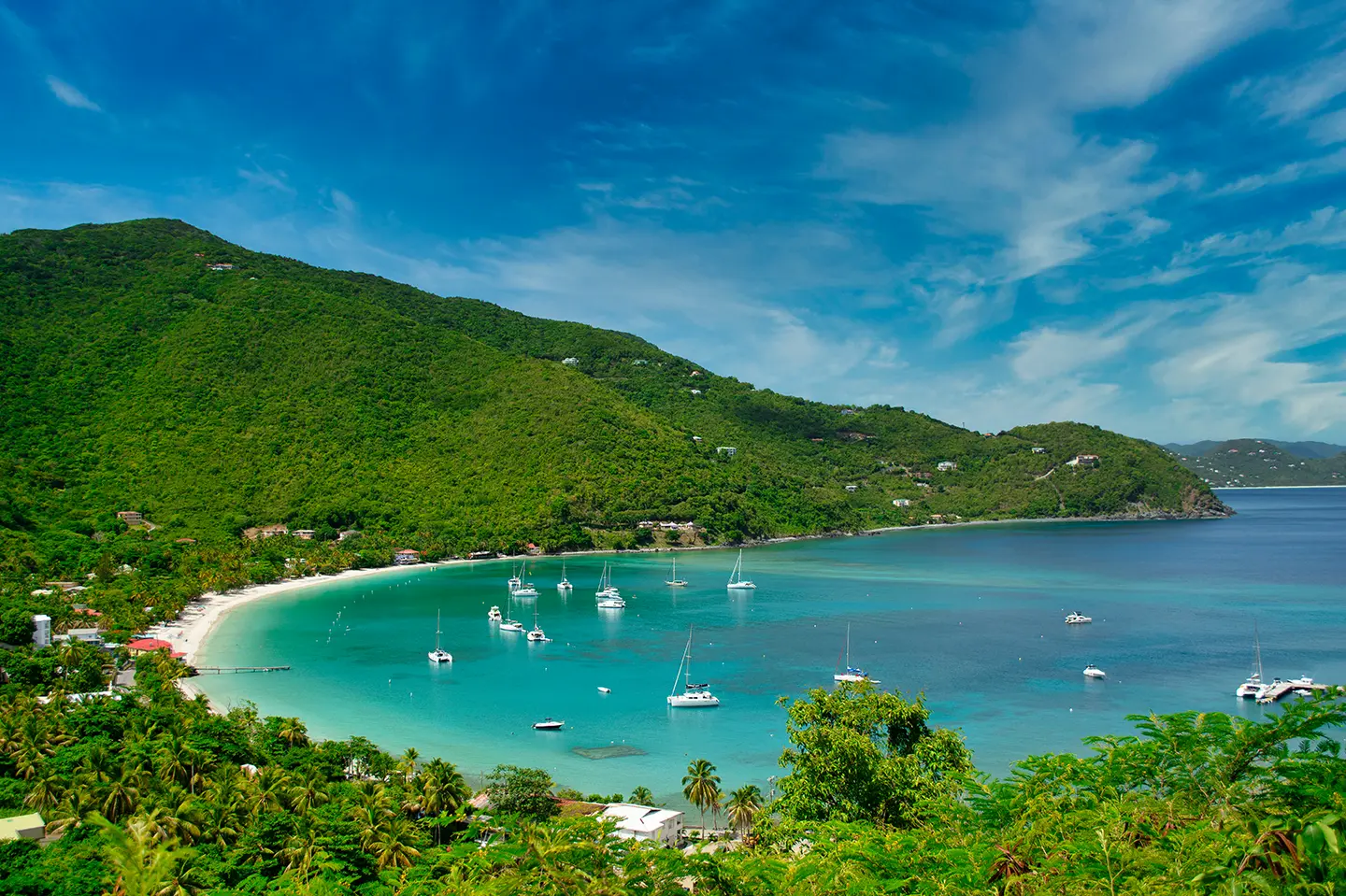
Catamaran charter British Virgin Islands is the most-recommended first bareboat in the Caribbean — and there's a structural reason behind that. Sir Francis Drake Channel runs east-to-west between Tortola and a wall of smaller islands (Norman, Peter, Cooper, Salt, Ginger, Virgin Gorda), enclosing a thirty-NM stretch of protected water where every destination is in line of sight of the next. A first-time crew can leave Road Town on Saturday afternoon, find the right island by Sunday morning without a chartplotter, and pull into a mooring before dusk every day of the week.
The BVI fleet runs roughly 400 bareboat catamarans across the four major operators — MarineMax Vacations, Dream Yacht Charter, Sunsail and The Moorings — plus another 100 hulls split between crewed-cat operators (CYOA, Festiva, BVI Yacht Charters) and smaller bareboat fleets. Catamarans dominate because shallow draft (1.0-1.4 m) opens sand-bottomed bays on Norman, Peter, Cooper and Virgin Gorda that a 2.0-m monohull keel has to admire from deeper water. Most hulls are 38-50 ft Lagoon, Bali, Leopard, Fountaine Pajot — three- and four-cabin layouts for groups of six to ten.
Trade winds are the second BVI advantage. The northeast easterly blows 15-22 knots from December through April, dropping to 12-18 in May/June, with rare lulls. Wind is steady enough to plan the week around — east-to-west legs on the morning breeze, anchor down by mid-afternoon before the trades freshen, sundown drink at the mooring. The water sits at 26-28 °C year-round; visibility on the snorkelling sites (The Indians, The Baths, RMS Rhone wreck) regularly exceeds 30 m.
Beyond the sailing logistics, the BVI is the easiest Caribbean clearance for US, UK and EU passport holders. Customs at Road Town, Cane Garden Bay and Sopers Hole runs daylight hours; the National Parks Trust handles mooring permits (paid on the boat by the charter operator); and the only paperwork most charterers ever see is the BVI Cruising Permit (~US$200 per week for a bareboat catamaran). Compared to the Bahamas (separate cruising permit + fishing permit), Grenada/Grenadines (SVG clearance EC$150 each way), or Martinique (EU-formal entry rules), the BVI is the lightest-paperwork charter zone in the region.
Where to base — Road Town vs Nanny Cay vs Sopers Hole
Three Tortola bases handle 95% of BVI bareboat departures. Road Town (the capital, east-end Tortola) is where The Moorings and Sunsail run their main fleets — 200+ catamarans on the dock, a 5-minute taxi from the cruise-ship pier and a 25-minute taxi from Beef Island Airport (EIS). Provisioning is straightforward at RiteWay supermarket on Wickhams Cay; restaurants and bars cluster around Road Town for the optional Friday-night arrival before the Saturday briefing.
Nanny Cay (3 NM west of Road Town) is the second-largest base — home to Dream Yacht Charter, MarineMax Vacations and several smaller operators. Nanny Cay has a hotel on the dock (Nanny Cay Resort), a chandlery, two restaurants, a pool — it functions as a self-contained marina village. Most charterers arriving on a late flight overnight at the resort before the morning briefing. Provisioning at the on-site mini-mart for early-morning departures.
Sopers Hole (west end of Tortola, at Soper's Hole Marina) is the smallest of the three bases — Voyage Charters and a handful of crewed operators work from here. The advantage is location: Sopers Hole sits at the western tip of the channel, so the first hop to Jost Van Dyke or Norman Island is short. Pick Sopers Hole only if you've chartered before and want to shave 90 minutes off the standard west-bound loop.
Sir Francis Drake Channel — the protected sailing zone
Drake Channel is the enclosed body of water between Tortola (north) and the line of smaller islands (south). The channel is approximately 25 NM long west-to-east and 3-5 NM wide. Trade winds blow from the northeast — meaning channel sailing is broad reach east-bound, close reach west-bound, with no upwind beating on a normal week. Wave height inside the channel stays low (typically 0.5-1.5 m) because the islands break the open-ocean swell.
Crossings out of the channel happen on three days of a typical week: Norman → Cooper / Salt (south side, 5-10 NM, protected lee of the southern wall), Cooper → Virgin Gorda (across the channel, 8-12 NM), and Virgin Gorda → Anegada (open-water crossing, 12-15 NM, only one outside the channel proper). Anegada is the one BVI passage that needs a real weather window — flat reef approach, marked channel, daylight-only entry.
Wind builds during the day. A typical schedule: morning breakfast on the mooring, slip lines around 10, sail two to three hours, anchor in lunch bay by 13:00 for swim + lunch. Afternoon hop of one to two hours to overnight anchorage. Mooring or hook set by 16:00 — well before the trades peak. Skipper-cooked dinner aboard or shore at the bar (Foxy's, Cooper Island Beach Club, Saba Rock, Last Resort). Most BVI nights involve a mooring within 200 m of a bar.
Tortola, The Indians and Norman Island
Most weeks start with a short westbound run to Norman Island — 6 NM from Road Town, 4 NM from Nanny Cay. Stop first at The Indians (3 NM south of Norman) to pick up a National Parks Trust mooring; the holding inside the channel rocks is shallow and mooring-only. Snorkel the pinnacles — coral fan, parrotfish, occasional reef shark. No anchoring, no fishing, no spearguns inside the park.
Norman Island is the day-one classic. The Caves on the west side of The Bight are best snorkelled before lunch (sand-floored, easy entry from the dinghy); afternoon swell tends to muddy the visibility. Drop the hook in The Bight overnight on a mooring — the holding outside the moorings is patchy and the moorings are well-maintained. Sand-only anchoring everywhere, even at lunch stops. The Willy T floating bar still anchors the Bight scene on weekend nights — Saturday and Sunday peak at 20-30 charter boats.
Day two often runs east across the channel to Cooper Island — 10 NM, broad reach, two to three hours. Cooper Island Beach Club has 30 moorings and the best beach bar dinner on the BVI route (book by VHF Channel 16 by 14:00 for the same evening). Alternative: stay south to Peter Island's Great Harbour or Deadman's Bay — quieter, fewer moorings, no shore-side restaurant.
Virgin Gorda, The Baths and North Sound
Day three is the Baths morning. Pick up a park mooring at Devil's Bay by mid-morning — the boulders + Devil's Bay swim are best before the day-boats arrive at 10:30. No overnight stay; the swell builds after dark and the moorings empty by 17:00. Bring water shoes for the boulder-trail walk; the rocks are sharp.
After lunch, push north to Virgin Gorda's North Sound — 6 NM, beam reach. The sound is sheltered by Mosquito Island and Necker Island, holding good in sand, plenty of room for tenders, water toys and the kite gear. Three mooring areas split the traffic: Leverick Bay (services, restaurant, dive shop), Saba Rock (small island bar, sunset views), Bitter End Yacht Club (rebuilt 2023, larger marina, on-site provisioning). North Sound is the natural Wednesday-night base for a week-long loop.
Day four is usually a North Sound layover for the kite, paddleboard or dive day. Optional excursion: dinghy to Eustatia Sound for the kitesurf zone (better wind), or motor across to the Dogs Islands for the snorkel (Bronco's anchorage, 4 NM north of Mosquito). Friday morning starts the run back west — typically a long broad-reach down the channel to Jost Van Dyke.
Jost Van Dyke, Anegada, and the optional north-shore run
Jost Van Dyke is the penultimate stop on most weeks. Great Harbour holds the moorings closest to Foxy's — the original BVI beach-bar legend. White Bay is the day stop for Soggy Dollar's painkiller (the BVI's signature rum drink) and the swim-up bar; calm-weather only, and the moorings fill by 11 a.m. in season. Little Harbour east of Great Harbour holds a smaller mooring field with lower season pressure.
Anegada is the one BVI destination that needs a real weather window. The island is a flat reef-fringed atoll 12 NM north of Tortola — different geography from the rest of the BVI volcanic chain. Approach is daylight-only, follow the marked channel; the channel is well-buoyed but the reef approach intimidates first-timers. Once inside, long beaches at Cow Wreck and Loblolly, and the lobster on the quay at Anegada Reef Hotel is fresh from the trap. Check your charter contract — some operators require Anegada approval in advance and some bareboats are ring-fenced from the route entirely.
An optional alternative on the Friday return run is the north-shore of Tortola — Cane Garden Bay (Bomba's Surfside Shack on the beach, Quito's Gazebo for live music) and Sopers Hole (Pussers' Landing for the rum-and-painkiller anniversary). North-shore anchorages are exposed to north swell from December through February and best avoided on northerly weather days.
When to sail, what it costs
Peak season runs December 15 through April 30. Christmas / New Year weeks are the busiest of the year — book 8-12 months ahead for catamarans. February school-break (US presidents' week, UK half-term) is the second peak. March and early April are easier to book at 4-6 months out. Day rates in peak: roughly US$8,000-15,000 per week for a 40-46 ft bareboat catamaran, plus US$2,000-4,000 for fuel/provisions/cleaning.
Shoulder season (May, June, early July, mid-November through mid-December) prices drop 25-35% — the same boat at US$5,500-10,000 per week. Sailing conditions are identical; the only material difference is hurricane window opens July 1. Most BVI operators close from mid-August through mid-October as a precaution. November reopens with the fleet refreshed and last-minute availability.
Beyond the bareboat fee, expect roughly US$200-400 for fuel (catamarans burn 4-8 USG/hour), US$300 for end cleaning, US$30-50 per night for National Parks Trust moorings, and a US$200 BVI Cruising Permit for the week. Provisioning runs roughly US$120-180 per person per day for a self-cooking crew, more for a fully provisioned crewed catamaran. We list every line in the offer — 72-hour free cancellation from booking, no surprises at the dock.
Catamaran charter by marina in British Virgin Islands
Jump straight to the catamarans based at each British Virgin Islands marina. Every link opens the live fleet for that home port — useful if you already know where you want to start and finish your week.
Wickhams Cay II Marina catamaran charter
On Wickhams Cay in central Road Town, Tortola, this is the largest charter dock in the BVI and the deepest concentration of bareboat catamarans in the territory. Norman Island, The Indians and the rest of Sir Francis Drake Channel open up just a short westbound hop away.
View catamarans at Wickhams Cay II MarinaNanny Cay Marina catamaran charter
A self-contained marina village a few miles west of Road Town on Tortola’s south coast, with the dock, chandlery and resort all in one place — handy for crews arriving on a late flight. Its westerly position trims the first leg to Jost Van Dyke and Norman Island.
View catamarans at Nanny Cay MarinaRitter House Marina catamaran charter
A smaller Road Town base on Wickhams Cay II, set right beside the capital’s shops and provisioning so a crew can stock up and clear out the same morning. It shares the easy channel run south to Peter and Cooper Islands.
View catamarans at Ritter House MarinaHodge’s Creek Marina catamaran charter
Tucked into the sheltered Maya Cove inlet on Tortola’s south-east shore, only minutes from Beef Island airport — a calm, protected start point that is also a natural hurricane hole. Cooper Island and the crossing to Virgin Gorda lie a comfortable first day to the east.
View catamarans at Hodge’s Creek MarinaFort Burt Marina catamaran charter
Right at the entrance to Road Town harbour beneath historic Fort Burt, this compact base puts a crew on open water within minutes of slipping lines. A good smaller-fleet alternative for a quick getaway down Drake Channel.
View catamarans at Fort Burt MarinaBritish Virgin Islands — questions answered.
When is the best month for catamaran charter British Virgin Islands?
December through April is the steady-weather window — 15-22 kt easterly trades, water at 26 °C, virtually zero rain. May and June are the brokers' shoulder: identical sailing, 25-35% cheaper. July through November runs hurricane window — most BVI operators close from mid-August through mid-October. December reopens with refreshed fleet and last-minute availability before Christmas peak.
Do I need a sailing licence to bareboat the BVI?
Yes. Operators require an ICC (International Certificate of Competence), US Coast Guard licence, RYA Day Skipper or equivalent national licence, plus a documented charter résumé or skipper-CV showing experience on a similar-size yacht. The BVI itself does not legally require a licence, but every reputable charter company contractually requires one. For crewed catamarans no licence is needed; the captain handles navigation, customs and the mooring fees.
How does the BVI compare to the Bahamas, Martinique or Grenada?
BVI is the easiest first bareboat — line-of-sight sailing, short hops, biggest fleet, lightest paperwork. Bahamas trades line-of-sight for turquoise shallow water and lagoons impossible to reach from a deeper-draft yacht (Sea of Abaco, Exumas). Martinique is the cheapest per-week (largest competition at Le Marin) and best provisioning (EU supply chain). Grenada and the Grenadines run longer passages but reach the Tobago Cays — the photogenic anchorage of the Eastern Caribbean — and stay open year-round because Grenada sits below the hurricane belt.
What's included in a BVI catamaran charter?
Yacht use, sails, dinghy with outboard, snorkelling gear, bedding, towels, full hull insurance, and third-party liability. Not included: fuel (US$200-400/week), end cleaning (~US$300), BVI Cruising Permit (~US$200/week for the boat), National Parks Trust mooring fees (US$30-50/night), and provisioning. Optional add-ons: starter pack (basic groceries dropped on board before arrival, ~US$300), full provisioning (~US$120-180 per person per day), and the gas refill (~US$15).
How far in advance should I book a BVI catamaran?
Christmas / New Year: 8-12 months ahead — catamarans go first. February US presidents' week and UK half-term: 6-8 months. January and March: 4-6 months. May / June shoulder: 2-3 months works for everything but the top three catamaran models (Lagoon 46, Bali 4.6, Leopard 45). Last-minute is mid-November as the fleet reopens after hurricane season — the early December weeks frequently have availability inside 6 weeks.
What's the BVI catamaran fleet size and which boats are most popular?
Roughly 400 bareboat catamarans across the four major operators — MarineMax Vacations, Dream Yacht Charter, Sunsail and The Moorings — plus another 100 hulls across crewed operators and smaller bareboat fleets. Most popular bareboats: Lagoon 42 and 46 (largest catamaran ranges in the BVI), Bali 4.6 (open deck-saloon layout), Fountaine Pajot Astréa 42, Leopard 45. Crewed fleet skews larger — Lagoon 50, 52 and 60, Sunreef 60, Bali 5.4. We broker across all operators.
Is Anegada bookable from any BVI charter?
Most operators allow Anegada with prior approval — typically signed off at the chart briefing on Saturday morning. The approach is daylight-only through the marked channel and requires settled trade-wind weather. A few entry-level catamaran models (older 38-40 footers, certain dual-engine layouts) are ring-fenced from Anegada by the operator due to draft or grounding-risk concerns. Confirm at booking if Anegada is non-negotiable for your itinerary; we will source a boat that allows it.
What's the weather pattern week-to-week?
Trade winds blow steadily — 15-22 kt from the east-northeast in peak season, dropping to 12-18 in shoulder season. Wind builds during the day and softens overnight. Cold fronts (norther swell) push through November-February — flat in the channel but make north-shore anchorages uncomfortable for 24-48 hours. Hurricane activity outside July-October is statistically zero. Squalls (brief 30-40 kt blow followed by sun) happen year-round and pass in 15-30 minutes — set the right anchor scope and they are a non-event.
400+ catamarans based in British Virgin Islands
Browse the live Caribbean fleet — sailing catamarans, power catamarans, bareboat or fully crewed. Filter by dates and group size; we'll quote within hours.
Live availability · 72 h free cancellation · No booking fees
Ready to plot a BVI week — we'll send the offer.
Tell us your dates and group — a Caribbean broker writes back inside one working day with a costed offer, charter agreement and the next available week.