
British Virgin Islands
& its routes.
1 sample 7- and 14-day catamaran route from the British Virgin Islands charter base. Each opens onto a day-by-day plan with map, mileage and mooring notes — adapt to your group, weather, and the kind of week you want.
British Virgin Islands, in the broker's words.
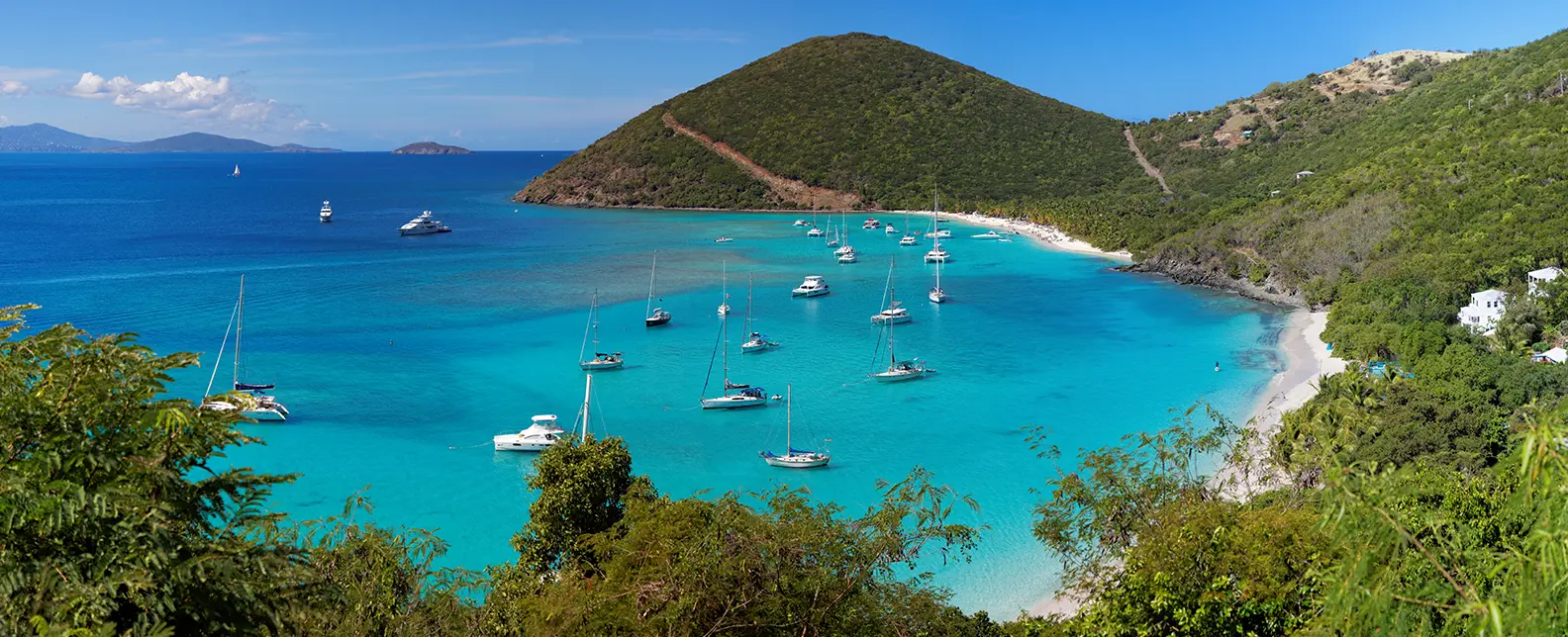
The British Virgin Islands are the most concentrated catamaran charter playground in the world — forty-plus islands and cays clustered inside a thirty-nautical-mile radius, with the main charter base at Road Town and Nanny Cay on Tortola. From a Saturday-afternoon briefing you can be anchored at The Indians for snorkelling by lunch the following day and ashore for dinner at Pirate's Bight by the same evening.
Sir Francis Drake Channel is the BVI's defining feature: an 18-nautical-mile sheltered corridor between Tortola and the southern chain (Norman, Peter, Salt, Cooper, Ginger, Virgin Gorda) that keeps daily passages under 12 NM and almost never exposes you to open ocean swell. The two notable open-water stretches are the run to Jost Van Dyke (mildly exposed at the channel mouth) and the 14-NM passage to Anegada — the country's only true blue-water sail and lobster capital.
Catamarans dominate the BVI fleet because the south sides of Tortola, Norman, Peter and Virgin Gorda are lined with shallow sand-bottomed bays where a 1.2-metre keel drops the hook in turquoise water that monohulls have to admire from deeper out. Combine that with bullet-consistent 15-22 knot easterly trades and the BVI become the canonical first bareboat destination for families, couples, and crews moving up from monohulls.
The charter season runs December through April at peak, with steady easterly trades, water at 26 °C and rainfall under 50 mm/month across the high season. May and June are the brokers' shoulder window — identical sailing, 25-35% cheaper rates, fewer charter boats on each mooring field. Hurricane window blocks July through November for most operators; the fleet reopens in mid-November with the December weeks frequently available inside 6 weeks. Christmas / New Year peaks 8-12 months ahead — catamarans go first.
Roughly 400 bareboat catamarans operate from the BVI across four major brands. The Moorings and Sunsail share the Road Town fleet (combined ~200 hulls, mostly Sunsail Moorings 4200 / 4500 series). Dream Yacht Charter and MarineMax Vacations split the Nanny Cay dock (~150 hulls, Lagoon 40 / 42 / 46 dominant plus Bali 4.4 and 4.6). Voyage Charters at Sopers Hole runs a smaller specialist fleet — Voyage 480 / 590 catamarans built locally. Crewed catamaran operators (CYOA, BVI Yacht Charters, Festiva) add ~100 hulls at the larger end (Lagoon 50, 52, 60 and Sunreef 60). Most bareboats are 3-4 years old; charter fleets renew on a 4-year cycle.
Three Tortola marinas handle 95% of departures. Road Town (east-end Tortola) is the busiest — 5 minutes from the cruise pier, 25 minutes from Beef Island Airport (EIS), 3 supermarkets within a 10-minute walk (RiteWay being the standard provisioning stop). Nanny Cay (3 NM west of Road Town) is a self-contained marina village — hotel on the dock for late-flight arrivals, chandlery, two restaurants, pool. Sopers Hole at the west tip of Tortola is the smallest base but the closest to Jost Van Dyke and Norman Island, shaving 90 minutes off the standard westbound first day. Departures from any of the three on Saturday afternoon, returns the following Saturday by 09:00.
Trade winds blow steadily on a clock — 15-22 kt from the east-northeast in peak season, 12-18 kt in shoulder season. Wave height inside the channel stays low (typically 0.5-1.5 m) because the islands break the open-ocean swell. Cold fronts (norther swell) push through November-February — flat in the channel but make north-shore anchorages on Tortola (Cane Garden Bay) uncomfortable for 24-48 hours. Squalls (brief 30-40 kt blow followed by sun) pass year-round in 15-30 minutes; set the right anchor scope and they are a non-event.
Costs beyond the bareboat fee: BVI Cruising Permit (~US$200/week for the boat), National Parks Trust mooring fees (US$30-50/night when picking up a buoy at The Indians, The Baths, Norman Island, White Bay), fuel (US$200-400/week), end cleaning (~US$300), and provisioning at US$120-180 per person per day for self-cooking crews. A peak-season 7-day BVI catamaran charter for six adults typically totals US$15,000-22,000 all in; shoulder season the same number drops to US$11,000-17,000.
The BVI suits first-time bareboaters, families with children of mixed swimming ability, multi-generational groups (the line-of-sight passages and short hops minimise crew fatigue), and crews moving up from monohulls. It is the easiest paperwork chain in the Caribbean — one cruising permit, no inter-island clearance, no language barrier (BVI is English-speaking, US dollar). For experienced sailors after firmer trades and longer passages, Grenada and the Grenadines run longer hops; for snorkelling shallow water at scale, the Bahamas Exumas; for French food and EUR pricing, Martinique.
British Virgin Islands — questions answered.
Tailor a British Virgin Islands week — we'll quote within hours.
Send dates and group size. A broker matches the catamaran, the route, and the weather window.